
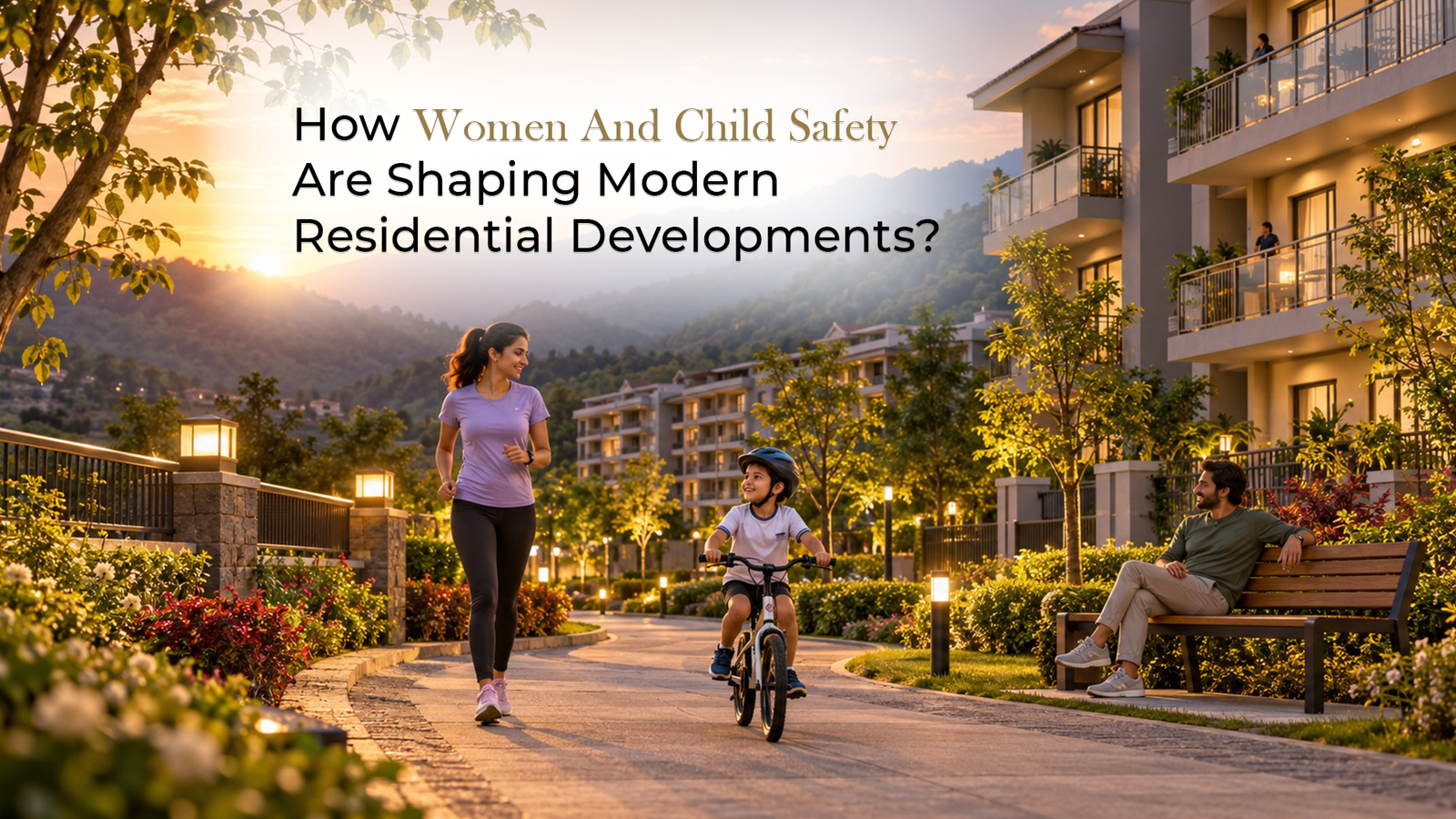
From well-lit walkways to safe play spaces, here’s how today’s homes are being designed around the people who use them most.
Forget the balcony view for a moment. Could your child cycle to the park alone, and could your mother walk home at 9pm without a second thought?
That one question is quietly changing how homes get designed. Women and child safety now sit right beside price, location and floor plan on almost every buyer’s checklist. The developers who listen are building very differently from those who don’t.
If you’re looking for a home in Haldwani, Uttarakhand or anywhere else, this guide shows what safety-first design really looks like. It also covers which features genuinely help and which questions are worth asking before you sign anything.
In short: women and child safety now shape almost every layout decision in modern residential developments: controlled entry, well-lit and visible walkways, pedestrian-first roads, secure play areas and responsive management. The best communities build safety into the design from day one, rather than bolting a gate on at the end.
Why has safety become the first thing homebuyers ask about?
Ask any family who has recently bought a home and you’ll hear the same story. The brochure got them interested, but the feeling of safety got them to decide.
Daily life has changed. More women commute, work late and exercise outdoors. More children grow up in apartments, where the playground is whatever the community provides. More families also live across generations, with grandparents who need a calm, secure place to walk. A neighbourhood that doesn’t work for all of them doesn’t really work.
That’s why safety has moved from a nice-to-have to a design brief. Planners now ask a different question. It’s no longer “how many amenities can we add?” but “who will use this space, at what time of day, and how will they feel there?”
What does a woman-friendly residential development look like?
It rarely looks like a fortress. It feels open, bright and easy to read, a place where you always know where you are and who’s around.
Light and visibility that work after dark
Dark corners are the real risk. Well-planned developments keep internal roads, pathways, parking areas and entrances evenly lit. They also keep sightlines clear, so nobody has to walk through a blind spot.
Landscaping is trimmed at eye level. Benches and walking tracks sit where windows and balconies overlook them. Urban planners call this natural surveillance, and the idea is simple: spaces feel safer when people can see them and be seen in them.
Controlled entry that doesn’t feel like a barrier
A staffed main gate, visitor registration, verification for delivery and domestic staff, and CCTV covering entry and exit points are now the baseline for a gated community. The better ones apply these rules every single time, because a rule that’s enforced only some of the time isn’t really a rule.
Gated plotted developments, such as Pallazio in Haldwani, show how controlled access can sit alongside tree-lined avenues, so security doesn’t have to feel like a barrier.
Safe routes from the front door to the car
Think about the walk from your lift to your parking bay at 10pm. Women-friendly design considers exactly that moment. It means well-lit and camera-covered lifts and stairwells, parking close to building entrances, and intercoms that actually work.
An internal walking or jogging track matters too. It lets women exercise before sunrise or after dinner without stepping onto an unlit public road.
[Place Image 2 here]
How are developments being designed to keep children safe?
Children don’t think about risk, so adults have to. The smartest developments make the safe choice the easy one.
Pedestrian-first roads
Traffic is the biggest everyday danger for young children. Modern layouts separate pedestrians from vehicles wherever possible. They also use speed breakers and low speed limits on internal roads, and set aside a clear drop-off point for school buses, so children aren’t dodging cars at the gate.
Play areas that parents can see
The best play spaces are fenced, shaded and positioned where residents can see them from home or from a nearby bench. Soft flooring, age-appropriate equipment and separate zones for toddlers and older children cut down on both injuries and arguments.
Township-style developments planned around shared spaces, such as Pal Sumeera Residency in Kichha, make this easier, because there’s room to place play areas where homes overlook them. When a play area is visible, children get independence and parents get peace of mind.
The small details that prevent big accidents
Safety often lives in the details you only notice when something goes wrong:
- Covered or fenced water tanks and ornamental ponds
- Balcony and terrace railings at safe heights, with narrow gaps
- Anti-slip flooring in wet and common areas
- Lift and stair lobbies that are well lit and visible from outside
Does technology make a community safer, or just look safer?
CCTV, RFID-based entry, intercoms, visitor-approval apps and panic buttons are all useful. But a camera only helps if someone watches the footage, stores it and acts on what it shows.
Technology works best when it supports trained people and clear procedures. A security guard who knows the residents, and a control room that responds quickly, will always beat a wall of cameras that nobody checks. So don’t just ask whether a development has CCTV. Ask who monitors it, and what happens next.
Why community matters as much as cameras
Safety isn’t only infrastructure. It grows from people who know each other. Residents who recognise their neighbours’ children notice when something feels off. Active resident welfare associations, regular safety drills, festival gatherings and morning walking groups all build that familiarity.
Developments that invest in people, through shared spaces, awareness programmes and inclusive events, end up with residents who look out for one another. Established communities that bring homes, open spaces and everyday connections together, like Palam City in Haldwani, show how daily routines turn neighbours into a network. That’s why more developers now treat people-first values as part of the planning brief, not an afterthought. No camera can replace that.
What should you check before choosing a home?
Brochures promise everything, but your own eyes tell you more. Use this checklist on your next site visit:
- Visit after dark and at different times of day. Walk the paths, the parking areas and the lift lobbies yourself.
- Ask how visitors are verified, including delivery staff and domestic help.
- Check CCTV coverage, who monitors it and how long footage is stored.
- Look at the lighting along internal roads, jogging tracks and parking.
- See where children play. Is the area fenced, visible from homes and away from traffic?
- Ask who to call in an emergency and how quickly management responds.
- Confirm approvals, RERA registration and compliance with government norms.
- Talk to current residents, especially women and parents, about daily life there.
If a developer happily answers every one of these, that’s a good sign. If the answers turn vague, that tells you something too. For more guides like this one, browse the SM Pal Group blog.
Frequently asked questions?
Safe design lets women move freely at any hour and lets children play without constant supervision. It removes everyday risks, from dark corridors to fast traffic, and gives families the confidence to use shared spaces, which makes the whole community healthier and more connected.
Look for well-lit paths and parking, controlled entry with visitor verification, CCTV at key points, safe lifts and stairwells, and a responsive security team. An internal walking or jogging track also lets women exercise safely at early or late hours.
Separating pedestrians from traffic is the biggest step, followed by fenced play areas that residents can see from their homes. Secure railings, covered water features, speed breakers and safe school-bus drop-off points let children move around independently without avoidable risks.
Generally, yes, when entry control is properly staffed and enforced. Gates limit unauthorised access, but real safety also depends on lighting, monitored CCTV, trained security and an active resident community. A gate on its own is never a complete guarantee.
Look for controlled entry, well-lit internal roads, actively monitored CCTV, fenced play areas and proper approvals. Visit after dark, speak to current residents and ask how management handles complaints. What you see on an ordinary evening tells you more than a brochure.
Yes, but only when people and processes back it up. CCTV, RFID entry and visitor apps deter misuse and speed up investigations, yet they need trained staff to monitor them, regular maintenance and clear response procedures to be genuinely useful.
Meera Pal is a Director of SM Pal Group, the Haldwani-based business group founded in 1982. She is part of the family leadership supporting the group’s growth across real estate, automobiles, frozen foods and stone supply, and a culture of trust and community respect.
Wrapping up
Safety isn’t a single feature. It’s light on the path, a gate that works, a play area you can see, neighbours who know your name and a management team that picks up the phone. Get those right and a house becomes a home your whole family can relax in.
That’s the thinking behind Pal Colonisers, the real estate arm of SM Pal Group. Its residential communities and plotted developments across Haldwani and Kichha are planned around shared spaces, open surroundings and a welcoming sense of community. SM Pal Group has been building in Uttarakhand since 1982, and its family-led board includes Meera Pal, Director of SM Pal Group, who supports a culture of trust, shared responsibility and respect for the communities the group serves.
That community-first outlook shows up in SM Pal Group’s community work too. Meera Pal’s social work in Haldwani is visible in moments like the group’s Women’s Day celebration, which she led to honour the strength, dignity and contributions of the women in its organisation and community. Across Uttarakhand, the SM Pal Group Foundation carries that spirit further, reaching more than 10,000 people every year.
Don’t take a brochure’s word for it. Visit a Pal Colonisers community, walk the paths after sunset, ask the questions from this guide and judge the difference yourself. Contact the SM Pal Group team to arrange your site visit today, and see for yourself how a safe, community-first home feels.